
All Roads Lead to the Honky Tonk

Around 8:00 PM on a Saturday night, I stumbled into a Nashville-themed honky-tonk bar in Scotland. Picture the worst parts of all your least favorite Nashville establishments. Not the real Nashville establishments that you frequent, but the kinds your mom’s friends saw on Instagram and insisted were the best, the kinds you had no choice but to resign yourself to. It looked just about like that.
Unlike my fellow travelers, who hailed from East Coast universities, I had my fill of honky-tonks, enough for multiple lifetimes. But my protests only made them more desperate to enter. Quickly, I realized I would have no choice in the matter. We had made the mistake of mentioning our destination to the bartender at our previous establishment as we grabbed our coats, hats, scarves, gloves, umbrellas—which still weren’t quite enough.
He gave a backward glance, then asked, “Are you sure?”
When my friends and I first saw the bright neon sign hours earlier—still in the daylight—we couldn’t help but slow down to look inside in the same sense that you’d take your foot off the gas on the highway to get a glimpse of a car fire. Now, we found ourselves willingly walking into the belly of the beast. A very loud belly. Loud enough that most of our conversation was reduced to confused shouts of “What?”
Though, in a state of shock, I had yet to find the words. Lights flashed everywhere from the ceiling, the walls, the overstimulating arcade games lined up against the wall. Women in crop tops and short shorts walked across the bar, which was enclosed like a zoo exhibit, and sang along to last year’s country Billboard Top 100. Granted, they didn’t know too many of the words. When they did, they would pick up their microphones and mumble into them.
I asked a friend whether this was a karaoke bar.
To which she replied, “What?”
Until I watched the women on the bar make their way down a set of steps, then resume their post behind the bar. This was worse than karaoke.
Patrons dressed in animal print and cowboy boots. They talked to one another in poor Southern accents as they waited in line for—yes—the mechanical bull. Finance men leaned over the bar for a closer look at the dancing bartenders. The bathroom sign was a mockup of a “Make America Great Again” lawn sign. I needed a moment to sit with it all, so a member of my party and I stayed behind to hold down the table as the rest went to order drinks.
“Do you think this is really how they perceive America?”
“What?”
I repeated myself.
“I don’t know.” My friend looked around and let out a sigh. “Probably.”
I talked my fair share of dirt about America, sure. Most Americans I knew did, but in the same way you’d talk about your siblings. Spend enough time around anyone, and you’re bound to find quirks you didn’t like. It was okay, so long as the criticism came from you, but the second someone else tried it?
It didn’t make me angry—that was the wrong word. Disturbed, definitely. I asked if she felt that too, and she gave a dejected nod.
I joked, “I mean, it’s not really that bad, is it?”
We shared a nervous chuckle, but neither of us found the question funny.
It crossed my mind to pry deeper, but my eye caught on a thick wad of gum on the stool to my right. Hers did too. She predicted that the token male of our group would sit in it by accident when he got back. This distracted us, if only momentarily. He did sit in the gum, and once we removed it, we tried and failed to hold conversation across the table. Once we grew tired of shouting, we abandoned the bar, ears ringing.
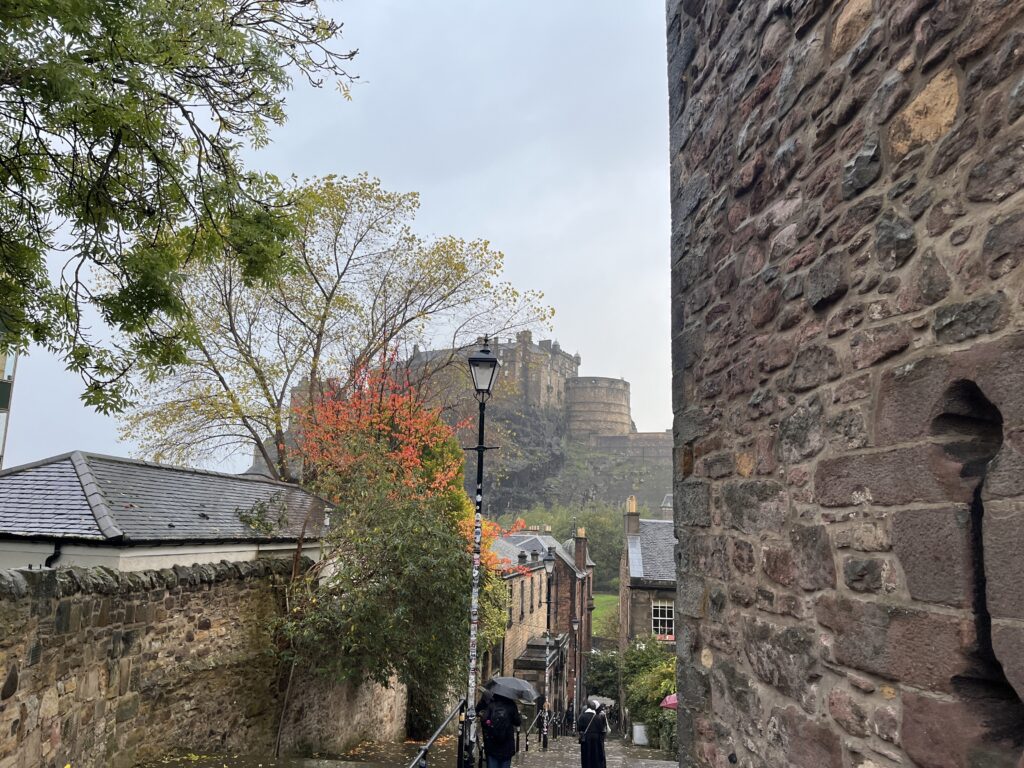
Leaving the honky-tonk reminded me of stepping out of a darkened movie theater and into the daylight. Except, in our case, we stumbled out of the European fantasy of America and into the gothic heart of Edinburgh. It left me with a similar feeling of disorientation.
Later that night, my friends and I mingled with a group of Norwegians visiting Scotland to celebrate a university graduation. They had a similar reaction to most Europeans, so I found, when they caught wind of our accents. It was the same wild bewilderment I afforded to safari animals from the confines of rickety Jeeps. If you look to your left, you’ll see a gaggle of American girls napping on the rocks—but do keep your hands inside the vehicle.
The conversation always starts the same way.
“What do you think of Norway?” one of the Norwegians asked.
We all exchanged a glance. None of us was particularly worldly, unlike the average European. Most of our parents and grandparents had never left and likely never would leave the county they were born in. We weren’t encouraged to explore beyond our borders, not in the way people did overseas.
Instead of saying, “You have nice reindeer,” I settled for, “I don’t know.”
It didn’t matter what we said, anyway. It was a polite transition for them to then tell us what they thought of America. If I were to paint a picture of the average European’s perception of the States, from my small data pool, it would look very much like our recently departed Scottish honky-tonk. Except with more guns.
Being surrounded by the European caricature of Americanism has forced me to come to terms with how I define America. Abroad, from the lips of others, our political figureheads are tethered to this definition—if they aren’t the definition itself. We aren’t taught to see one another with nuance. The worst of what we read in the headlines is what we remember.
Distance has helped me refine my own definition. America is floating in my neighbor’s pool listening to Billy Joel. The smell of homemade burgers from someone else’s backyard. It’s driving down the highway on a crisp night blasting Bob Dylan, shouting along. My father, covered in dirt, helping a woman dig her car out of the mud. Smiling hello to strangers. New York pizza. The large flag hanging from the tree I grew up climbing, a flag that somehow means all of these things at once to me and something completely different to everyone else.
The guitarist at the next pub began to play a familiar tune. We leapt from our seats and flailed around to “Dancing in the Dark.” We sang every word, even if we were the only ones that knew them, and against our intentions, announced ourselves as American. We didn’t necessarily care, not like we did in the honky-tonk, because we are from New Jersey and they were playing Springsteen and we were reunited for a few fleeting minutes with something we thought we left behind overseas.
Both the honky-tonk and the narrow pub, even if we disagree, can hold someone’s definition of America. They exist together: the realities of a country and the hope for what it can be. I’d like to think it’s the same everywhere, even if other countries have more reindeer.

More from this Author
-

An American in Parliament
If messages of the manosphere are already so deeply ingrained in victims, what approach is required to help them? Or is there simply no way to reach someone who doesn’t want to be reached?
-
Pants
Never tell a Brit you like their pants. And some of them wear really nice ones. Corduroy has come back in style. Autumn
-
Windows
On the far side of my room, about a foot from my heels where they dangle off the edge of my mattress, is
Ready to Travel?
Are you curious and ready to dream big? Do you desire to challenge yourself and make a meaningful difference? Become a Lumos Traveler - let’s get you started!