Category Archives: Travel

Adventure with Mcha

.

.

It’s hard to believe I’ve officially been in Africa for an entire month. The first few days and weeks it didn’t feel real. I would wake up every morning in disbelief that I was actually in Africa. It wasn’t until the trip to Zanzibar which was when I finally accepted I was in Africa. Throughout the week I’m at the hospital, Muhimbili National, from 8a-3:30p. The commute to and from work is about an hour. The weekends are when I go on adventures. Two weekends ago was when I went on an adventure to Zanzibar. We had a tour guide by the name of Mr. Alewei and we did so many amazing things. We left Tanzania early in the morning by ferry and met Mr. Alewei upon arrival. I learned that Tanzania’s original name use to be Tanganyika. It wasn’t until 1964 that Tanganyika and Zanzibar joined together. The “Tan” is for Tanganyika, the “Zan” is for Zanzibar, and the “Nia” means to come together. The first day we got a tour of Stone Town which is a very historical part of Zanzibar. We took a boat to Prison Island where we had a tour. When slaves would act out to their owners in Zanzibar they would send them to the island to be prisoners. There were huge turtles on the island that we got to feed and play with! The oldest one was 192 years old.

IMG_4568

They are protected by Zanzibar and have a safe home on the island. We snorkeled on the island and then went to a place where we had a spice tour. There were SO many types of spices! They would pull off a leave on a plant and have you smell it and guess what it is. I ate the bark from a cinnamon tree and it tasted just like Red Hot gum! After smelling all of the different spices we watched a man climb the coconut tree and throw down the coconuts. They then cracked the coconuts open for us and we got to drink the juice. The people from the spice tour made us grass crowns, bracelets, rings, and necklaces.

IMG_4636

IMG_4655

Mr. Alewei is the gentleman squatting. And these are some of the great friends I have made who are also working in the hospital.

It was absolutely amazing! Afterwards, they fed us fresh fruits that are all grown on the island. There were fruits I ate that I had never heard of before like laichi and jack fruit. The next day we got the chance to swim with dolphins and go to Jozani which is a national park. The forest was so breathtaking! I got the chance to see SO many monkeys in their natural habitat! It was unbelievable. The monkeys would run right in front of you or right beside your feet and swing from branches just in front of your face. There are two monkeys native to the island. One of those monkeys you can find all throughout Africa; however, the Red Colobus Monkey is only found in Zanzibar.

IMG_4801

This is a baby monkey being nursed by its mother.

I also got to see Mangroves all throughout the forest. These are trees that can only live in salt water and the roots of the trees actually grow above ground because of the lack of oxygen under ground.

IMG_4820

Zanzibar was such a beautiful place and it was quite different compared to Dar es Salaam. You felt a lot safer in Zanzibar. I could actually carry my phone in my hand while I was walking out in public and carry a bag with me. Thefts weren’t as prevalent there as they are in Dar. The economy of Zanzibar relies so heavily upon tourists whereas Dar doesn’t have as much tourists. There is a lot more poverty in Dar compared to the people who live in Zanzibar. However, there is still poverty there. I passed by many homes and villages that were very rural and looked poverty stricken. Moreover, the population of Zanzibar is very diverse! 90% of the population is Muslim. A lot of people spoke in Arabic and there were many buildings that had Arabic writing. Luckily, a guy that was on the trip with me, Saqib, knows Arabic and was brought up Muslim. He taught me a lot and I had the chance to hear him speak to some of the natives in Arabic. It was really cool to see. A lot of people were in hijabs and modestly dressed. There are also a lot of Muslim people in Dar but not as much as I saw in Zanzibar. Dar is about 50% Muslim, 50% Christian. So although I had an absolutely unforgettable experience and trip to Zanzibar there is one person that I really hold dear to my heart and was my favorite part of the trip. Everyone, please meet Mcha.

Mcha from Zanzibar

Mcha from Zanzibar

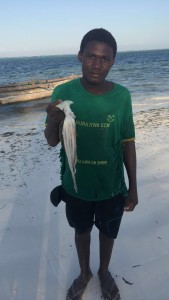
He’s a 15 year old boy who’s a fishermen. I was attempting to go out to the sea with a friend from Work the World named Saqib, because the tide was really low and there was about a mile or so of shallow water and then you could reach the reef. He approached us with his fish he had caught that day, which you can see in this picture

IMG_0260

and asked if we were trying to go out. He spoke very little English but we were still able to communicate with the broken Swahili we new and the broken English he knew. He led the path and along the way he showed us his world in the water. This was a time that I really learned the importance of non-verbal language. Even though we couldn’t communicate through words I could still understand everything Mcha wanted me to. He would find beautiful sea shells and just hand them to me. He would find star fish after star fish and I never once spotted one.

IMG_0302

He would find these sea creatures in shells and told us the names of all of them. There were sea urchins EVERYWHERE! He would make sure we didn’t get hurt by them. As we were heading back there was a little rock in the water. All of a sudden he said there’s an octopus underneath there! I had NO IDEA how he even saw it! It didn’t look like anything would be underneath the small rock. He reached under the rock and I saw ink everywhere in the water! HE WAS RIGHT! There really was one!!! After battling and battling and the tide rising and rising  he eventually won the fight. Thr water was at first just below our mid-calves and it was now way above my knees. The tide had risen a good 2 feet and we still had a good mile to go to get to shore. We made it back just in time and that’s when I captured the first photo up above. This little boy has a heart of gold and is such a hard worker. Could you imagine supporting your family at the age of 15 and fishing all day long so your family has food to eat? He had an even younger brother too who was also fishing. Him finding things so easily in the sea taught me how I need to change my perspective.

If you’re walking blind and not looking for things around you then you’ll miss them. Just like I missed all of the beautiful things in the sea until he showed me. That’s something Africa as a whole has taught me. To really open your eyes.

I am going home!

My project with Lumos and Projects Abroad is about to come to an end, and home is coming. I am going home! No, not in the United States yet, but in Fuzhou China.

The beautiful city of Fuzhou, the capital of Fujian province of China. This is a city that is touched by the seas and surrounded by mountains with a rich history of Chinese civilization and is renowned for its fresh air and nature. Most importantly it my ancestral home, where everything started for me and my family.

In my culture, family is a big deal in life, perhaps the biggest. When someone turns 70, they will have a birthday celebration in honor of them. And that is what our family did for my grandparents. This is a big deal, my family members from everywhere in China and the United States flew back to Fuzhou just for this occasion so I too traveled back home.

It is always the best feeling when you come home to the warmth of your grandparents. It feels identical to going home in the US. Maybe because I have already accepted China as another home for me. My first task in Fuzhou is go to the small village where we all lived in since my great great grandparents. It is the village where my father is born. It is small but beautiful with blue sky’s and lush forests. The population there is very small, a lot of these folks immigrated to the United States like my parents. In this village, I learned more about my family’s history and felt more connected to my roots as I retraced the footsteps of generation and generation of family members.

In the afternoon, we descended from the mountain back to the main city of Fuzhou, where we currently live. After meeting and remeeting so many friends and family, the big event finally occurred.  The celebration of my grandparents is massive! Friends and families from near and far all dine and share stories and laughter. I wish my grandparents the best of luck and health, and I made a promise to them to visit as often as I can. Coincidentally, that is also what they wished for as they blew out the candles on their cake.

The journey back to Shanghai felt like leaving home. I wished I had more time to spend with my family and to learn more about my past. But strange enough, as I arrived in Shanghai, it also felt like coming back home. I guess home is where you love and home is something that can infinitely exist anywhere.

IMG_2236

Here is the “mayor’s” office in our small village home. This is also where we worship. There is temple dedicated to our family and community.

IMG_2245

Nothing is better than being with family; that is the best part of being home.

Lost in Heaven

There is an old Chinese saying, 上有天堂下有苏杭 (Shang you tian tang xia you Su Hang). This means up above us there is the Heaven, down here there is Suzhou and Hangzhou. This saying compares Heaven to Suzhou and Hangzhou; ever since ancient times these cities are renowned for its beauty and civilization.  Last week I visited Suzhou, so it is only fair to visit the beautiful and bigger city of Hangzhou.

Before Shanghai is the megacity as it is today, Eastern China flourished with the cities of Hangzhou and Suzhou. These two served as major economical and cultural centers of ancient China. Hangzhou has even been a capital of China once! Of course we know Marco Polo called Suzhou and its surrounding towns as the Venice of China, but Marco Polo adored Hangzhou the most. Marco Polo visited Hangzhou and fell in love. With the culture, people, and the West Lake. He vowed to come back again. Later in his life, Marco Polo came back to Hangzhou and even served as the mayor of Hangzhou for quite some time.

My journey to Hangzhou is a valuable experience. I woke up and rushed to the station, and in my tight time frame, I forgot to bring my phone charger! So for the entire day I was trying to save my battery (hence there are no pictures in this post). I also forgot my credit card which would come back to haunt me later. I had with me my backpack and some cash.

In Hangzhou, it was indeed  very developed and proud city. Hangzhou is the capital of Zhejiang province and is considered one of the cultural centers of China. When you enter the city, you feel like you are in any big Chinese city, except Hangzhou made you also feel the years of tradition it has. The main attraction is the West Lake. A beautiful and enormous lake that has attracted many visitors and inspired the works of many Chinese poets and artists. It is not as tranquil as Zhouzhuang, but it was more grand and full of history. I did my best walking through the famous bridges and along the West Lake. It is very big and in the center of the city, it is kind of like Central Park in NYC. One side of the lake you see the tall skyscrapers and the other side you sea dozens of mountains and the blue sky. During my stay, I also visited the site of the Longjing (Dragon Well) tea. The same tea that Emperor Qianlong, Obama, and Queen Elizabeth drank! Hangzhou prides itself with tea and tea plays a huge role in the history and identity of Hangzhou and Zhejiang province. At night, there was the spectacular “Impression West Lake” by the famous Chinese director, Zhang Yimou. This is a play that actually takes place on West Lake! The entire West Lake is the background decorated with lights and an incredible performance of Hangzhou’s traditions, stories, and memories in an East-meets-West style. This show is really something out of this world and needs to be seen to explain.

At the end of my journey, the trouble started. I spent ALL my cash very quick! Oh how I wished I had my credit card. I tried my best to arrive at the train station to catch my train to Shanghai, only to discover there was a problem with my passport that does not let me board the train. After a long time struggling (and no money), I managed to get a ride back to Shanghai but I had to wait A LONG time at the station. I waited, starving (skipped lunch) and thirsty. I had no phone, and no time either! I had to rush back to Shanghai ASAP to catch my metro home before it closes because I have zero cash for a taxi. This experience has been a valuable one. It has taught me first to be more careful, be more humble, and glad that I am bilingual. It made me come back to earth after I was lost in Heaven. It has a difficult journey, but in a way, I am glad it happened. In the end I managed to get on the train (no seat for me) and caught the absolute last metro home. Hangzhou has been a great and valuable experience, but Shanghai welcomed me with open arms and a warm bowl of noodles!

The Venice of China

In a small small town right outside of Suzhou (one of the major cities near Shanghai) lies a very renowned place called Zhouzhuang. Zhouzhuang is an ancient water town, like what Shanghai was maybe 800 years ago. It is surrounded by rivers and canals and the architecture still has not changed since ancient times. This is what makes Zhouzhuang so unique and beautiful. It is so beautiful, that when Marco Polo visited Zhouzhuang, he said it is the Venice of China. I have never been to Venice, but after being to Zhouzhuang, Venice must be very beautiful.

Zhouzhuang is kind of hidden away from the major surrounding cities, Shanghai, Hangzhou, Suzhou, Wuxi, and Nanjing. I took a quick night layover in Suzhou from Shanghai by train, then I headed to the small city of Tongli by metro, then I went to the even smaller town of Jiangfen by bus. From there, I walked to the even smaller Zhouzhuang. What a journey! But it was worth it.

When you enter Zhouzhuang, it is like stepping back in time. Is this even China? It sure isn’t anything like the busy Shanghai life. The locals here were all very much so relaxed and hospitable and welcoming to visitors. Besides the the abundant amount of tourists, everything felt tranquil and at peace. The city is built around canals and rivers and it is connected by bridges everywhere. These bridges have a lot of meaning to them, like the Green Dragon bridge, Double Luck bridge, all have a deep meaning behind them. The main mode of transportation here is of course by boat! A slender wooden and traditional looking boat rowed by locals. They would row across the numerous waterways singing songs in an ancient language. The atmosphere and air of the city was more than just romantic, maybe just like Venice.

I explored Zhouzhuang as best as I can, following every old street and river. I was content with the village and saw the day, night, sunrise, sunset, sunshine, and rain and how it changes the beauty of Zhouzhuang, every time to a different picture.

Zhouzhuang is a hidden gem hidden in some of the most popular and biggest cities in China, it is easy to miss. But a quick escape from the busy city life would take you back in time to a place unlike any. I would really recommend Zhouzhuang to anyone visiting China. After my trip to Zhouzhuang, I am really considering visiting Venice, the Zhouzhuang of Italy.

IMG_1931

Boats line up along these old streets and even older canals. Rowing boats is the main mode of transportation here!

IMG_2030

The gate and pagoda right outside the border of the village of Zhouzhuang. It was a very warm welcome!

IMG_1945

Being at Zhouzhuang, listening to the songs, watching the water flow, appreciating the atmosphere, and living every second of it, is an unforgettable experience.

In Almost a Month…

Karibu! My dear grandmother’s friend who lives in Dar es Salaam taught me that saying. It means greetings/welcome in Swahili. Thank you for joining me on this very exciting journey I will be pursuing! I can’t believe everything that is going on in my life! So much has happened in such a little amount of time that it is hard to process everything so quickly. But I am so blessed and humble for everything that is happening. I am currently writing my first blog in good ole’ TN on my porch next to my cat. As I look out into the woods and watch the breeze blow through the trees and feel the cool wind against my face I try to figure out how to say what I am feeling. In a little over a month, July the 14th, I will be leaving for Africa, where I will be interning and working as nurse. My first 9 weeks will be at Muhimbili National Hospital in Dar es Salaam. At this hospital I will be exposed to many clinical rotations. I am very interested to see the comparison and contrast in the hospital’s there compared to US. My first two weeks I will be in OB, my next two weeks mental health, the following two weeks will be in ER/trauma, and my last three weeks in the city hospital will be in pediatrics. My last week in Africa, week 10, I will be doing the Kidodi village experience where I will be staying with a host family in the village and working in the Kidodi Village Rural Healthcare Clinic. My heart bounds with joy and fear when I think about all of the things I will encounter. I will be traveling by myself on a flight that is about 24 hours long. I currently am finalizing all of my vaccinations and prepping myself to learn Swahili.

Almost a month ago I graduated from Belmont and I begin working as a camp nurse in Wisconsin in two days. I will be there for a month right before I leave for Africa. Yesterday I took the state licensure to become an actual registered nurse (RN). It takes about 48 hours to hear whether you passed or fail; so fingers crossed! With all of that going on, the reality of working in Africa for almost 3 months has not felt as real. However, as the days are getting closer my heart beats faster and it is becoming more of a reality. The main thing I am most excited for is just getting to know the people. I love engulfing myself into other cultures. When I am in Africa I will be the farthest away from home I have ever been as well as for the longest amount of time I have ever been away from TN. By being away so long I feel that I will be able to really live the culture that I am going to be going into. Although I do not know anyone else who will be doing Work the World, which is the organization I am going with, I am excited to see what is in store. One of my main goals is to really get to know the people in Africa and make the most of every second I am there. I will be working in the hospital from 8AM-4PM, Mon-Fri. I will have the evenings free and the weekends free. During those free times when I am not learning in the hospital I hope to really explore the area and become friends with the local people who live there. I will definitely be stepping out of my comfort zone but that is the only way we can truly grow. I guess the next time I will be writing will be right before I leave! I’ll talk to ya soon! And thank you so much for joining me and reading my blogs! I can’t wait to experience this Lumos Journey with you!

-Karah

An infinite potential to achieve your dreams

Madame Lu is born and raised in Shanghai in a tumultuous time. A time of political turmoil, Japanese occupation, and a Chinese civil war. Madame Lu has endured many hardships in her life, but the one thing she will always have to endure is cerebral palsy (CP).

CP is a condition that affects the muscle coordination and control that limits the functional abilities of the individuals. This causes spasms in the muscles and nerves of the individual and they can not do the simple things that we take for granted, such as using chopsticks, writing, and walking. A lot of the times, there will also be mental and speech disabilities. The worst part is, CP is not curable.

Madame Lu might have been born with CP, but the disability did not prevent her from dreaming and achieving great things.  Madame Lu poured out all of her time, resources, and heart into creating Cerecare Wellness Center in Shanghai. This is a facility that offers an alternative therapy approach to assist children with CP to adjust to normal life. By providing them care and education on their developmental level, and to provide teaching in activities of daily living such as eating with utensils and walking. Cerecare also adds an additional therapy of traditional acupressure, which Madame Lu claims to have helped her the most during her therapies. These interventions are provided by a team of kind hearted individuals who are devoted to help the children adjust their lives to society.

Projects Abroad assigned me to volunteer here with Cerecare for my two months here, and it has already been a week since I started working here. The first day was initiated with intensity. I was introduced to the history, facility, and staff of Cerecare and was greeted with a warm welcome. Then I met the children of Cerecare, currently with 15. The children all had either a form of CP or Autism and the age range varied from 5 years old to 18. Each of these children their own different disabilities and unique strengths and weaknesses. The children all were very welcoming and eager to earn more about their new friend, an American 哥哥 (older brother) who for some reason looks Chinese. After spending a week with these children teaching English, performing stretching and physical exercise, doing math, helping them eat, and just spending genuine time with them I had learned a lot about each of these children. Each are all so different in their own way, DuoDuo wants to be a singer, XingXing wants to be an actress, JiangJiang wants to help out with their parent’s shop. Each were all eager to share with me their hobbies and dreams. While they were all different, I knew they all had in common something like Madame Lu, an infinite potential for growth and means to achieve great things. These children are all so bright and has a great future ahead of them.

As for now, it begins my two month adventure at Cerecare and the amazing people I have met along the day.  I wake up every morning at 7:00 to catch my bus to work which starts at 8:30 and ends at 5:00 pm. Afterwards I usually spend my day exploring the amazing city of Shanghai. Needless to say, these two months will be some of the bests.

TBC

http://www.2wheels.org.uk/cerecare.asp

http://www.cerecare.org/

Inshallah

The idea of writing this final post has been, in a word, overwhelming. I have certainly struggled throughout this experience with how to best articulate all of the complex experiences I’ve had into accessible and engaging posts for this blog, but this is on a level all its own.

This, ladies and gentlemen, is the recap.

This is the last post I will write regarding my life-changing adventure in Morocco. It is also the first post that anyone visiting this blog in the future will see. Embracing that duality, if you’re curious about any specific topics regarding my time in Morocco, here is an abbreviated list with shortcuts to the accompanying posts:

How much do you actually know about Morocco? Improve your knowledge and click here! You can also get my initial impressions here and here!

 
Want to learn more about the rationale and execution of my project in women’s empowerment? Click herehere, and/or here!

For fun travel reviews, click here and/or here. Morocco is a safe, welcoming, and economic travel destination for solo travelers as well as family vacations! Tourism does a great deal for their economic development too, so PLEASE consider planning a trip soon!

Curious about Islamist and/or Moroccan culture? Click herehere, and/or here for some personal stories!

image

Above is the amazing local staff of my nonprofit, Cross Cultural Solutions. They were my encouragers, challengers, and protectors. But most of all, they were my dearest friends and confidantes in the volunteer house. Two of these staff members are former PeaceCorps employees, which was a terrific resource for me to explore as I continue to pursue next steps in postgrad employment. The other two staff members did not speak much English, which makes their friendships uniquely valued to me. These are people who have only communicated with me through a common second language. The reason this is so special to me is because I have a theory about how our personalities change based on how we are able to communicate in any given language. (I’m not the only one either... check it out!) In my first language, I can express a seemingly infinite amount of nuances and emotions. But that’s much more difficult to accomplish in a second, third, or fourth language. So to have been able to make friends despite the limited self-expression of a second language is quite meaningful to me! Overall, my wonderful experience in Morocco would not have been possible without these four incredible individuals.

image

Cross Cultural Solutions is an exemplary nonprofit that I am grateful to have called my sponsoring partner in executing this project. If you have any interest in volunteering abroad, I strongly encourage you to investigate their programs on their website. They have well-developed programs working toward sustainable impact in Morocco, India, Tanzania, Costa Rica, Ghana, Peru, Thailand, and Guatemala. They provide excellent customer service before, during, and after their programs, and they do a particularly great job ensuring the safety of volunteers while abroad. Please feel free to ask any questions about working with CCS if you’re interested!

image

Shukran bezzaf, thank you SO much, for being a part of this adventure with me. I was motivated that my women’s empowerment project indeed addressed a profound, ongoing problem in this country, and I can only hope that the work I did over the last three months made an impact on at least one person I interacted with. Education is the key to empowerment, and I am so grateful to have had the platform I did with so many different audiences to initiate these tough discussions. Sometimes it was difficult to change classes, but at the end of the day it was for the best. My impact was much further spread as a result. Please continue to share this blog with your friends, your family, and anyone else you may come across that could benefit from these stories. One of the primary goals of the Lumos fellowship is to continue to advocate and share about your experiences, maintaining an infinite cross cultural dialogue. So I invite all of you who have so kindly taken the time to read this blog to join me in pursuing that. Inshallah, or God willing, this is not where the adventure ends.

image

Finally, in true Belmont fashion, I’ll conclude with some fun music recommendations of songs I couldn’t stop singing during my time abroad. Check them out! “Zina” by Babylone“Maria” by Faydee“Habib Galbi” by A-WA“Sahranine” by Carole Samaha, and “Kolly Melkak” by Sherine.

For those of you in Nashville, stay tuned for the date of my project presentation on Belmont’s campus later this fall. Looking forward to seeing you all soon! All my love!

A Girl Named Jihad

This is the story of my dearest friend here in Rabat. She is 20 years old, the second of three daughters. She lives in a cozy apartment with her family about 10 minutes away from me. She is a passionate economics major at the local university, and she speaks French, Arabic, Darija, and quite a bit of English. She loves the Egyptian singer Sherine, the color pink, and reading lots of books in her spare time. Last week, she was hired to her first ever job , which is a very big deal in a country with such a depressing unemployment rate. She is compassionate, curious, and wise beyond her years.

And her name is Jihad.

image

Don’t worry, I did a double take too when she first introduced herself to me at the bus stop. “Jihad” is a word we’ve all seen and heard before, thanks to the frequent use of the term in the media to reference ISIS. The definition of “jihad” that we are most familiar with is that of a holy war.  Admittedly curious and taken aback by my new friend’s name, I decided to do some research... Did you know that “holy war” is not  actually the primary definition of the word? In fact, the way we use “jihad” is linguistically incorrect, as the proper word for war would be “al-harb”. Instead, jihad actually means to put forth a great effort. In Islam, Muslims can use this word to describe three different types of challenges that require great effort. The first and most commonly used meaning is the challenge of living out the Islamic faith in all aspects of life. The second is the challenge of building and maintaining a good Muslim community. It is in the third and final definition, the challenge to defend Islam, where the definition “holy war” comes into play.  All three definitions of the word are technically correct, even though they are not all equally used.

So to put this in a potentially more accessible context, let’s take the word August. When we hear the word August, it is safe to assume that we are likely referring to the eighth month of the year. That is the primary definition and most commonly intended meaning. However, the word can also correctly be used as an adjective to describe something or someone that is respected or impressive. The frequency with which English speakers use the word “august” to describe something impressive is about the same frequency as Arabic speakers would use “jihad” to mean holy war. While “august” is not an ideal example because it changes the part of speech for its two definitions, it is the best example I could come up with to illustrate my point. Plus, both words can are used as names, which is all too fitting toward the point I hope to make!

image

When I first met Jihad, I didn’t know how to react when she introduced herself. But after my research, I felt guilty for my presumptuous concerns. Once I had properly addressed those concerns by seeking to rectify my discomfort, I felt as if I ought to re-introduce her to myself to make up for my ignorance. I imagine some of you may relate.

As I mentioned before, Jihad and I met at a bus station in downtown Rabat. I was waiting for my other friend outside of the hammam (bathhouse: an experience I thoroughly recommend) when she and her mother approached me to ask about whether or not the bus had already passed by. She was by far the most joyful person I had ever met, and I enjoyed chatting with her and her mother as they waited for their bus. About 20 minutes later, we swapped numbers and said goodbye. This is a common practice in Morocco, as the locals almost always go out of their way to make you feel welcome in their country. I never expected to see her again, but I was so grateful for her refreshing conversation and contagiously positive attitude. So when she invited me to her home for Sunday lunch two weeks later, I figured why not?

image

However, I simply was not prepared for the onslaught of generosity, acceptance, and love that would envelope me during my visit. I spent five hours at their house talking, laughing, listening to music, and looking at old family photos. As Jihad told me to story of her aunt making the hajj (pilgrimage) to Mecca, Jihad’s mother insisted on sharing one of the prized dates leftover from her sister’s trip, along with a sip of water from the Zam Zam Well, which absolutely blew me away. Muslims believe the Zam Zam Well is the spring where God supplied Abraham with water for his son Ismail, and consequently it holds a tremendous amount of religious significance. The water is believed to be miraculous, with unique healing properties. So the fact that this family insisted on sharing their limited supply of such extremely sacred gifts with me, someone they know is not Muslim, was simply overwhelming. I do not think I will ever be able to articulate the raw beauty and humanity of that specific moment.

But the thing I appreciate most about Jihad is, without a doubt, her candor. I often forget that a language barrier even exists between us as we discuss the news, talk about our hopes for the future, and (of course) watch the Olympics! In fact, when the news broke that a Moroccan boxer had been detained for allegedly sexually assaulting two maids in the Olympic village, we had a fantastically cross-cultural dialogue about how the systemic double standards of sexual abuse translate in our respective countries.

These are the conversations that reminded me of the true range and value of our common humanity.

As I left Jihad’s home for the last time, I could not help but marvel at the insurmountable depth that her companionship has added to my experience in my last few weeks. She has inspired so many more questions and curiosities about the Islamist world, particularly anthropologically, all of which I intend to continue to explore  in adventures to come. Though I cannot help but be amused as I think back to how it all started... With a misconception of what is truly a beautiful name.


Once Upon a Moroccan Wedding

One of my favorite parts about my job at Feminin Pluriel was the wide variety of students that I got to work with and invest in... Everything from 6 year old beginners to astrophysicists seeking to improve their writing abilities for their PhD dissertations! It was through my work at the center that I met Noureddine, a computer designer in my advanced conversation class. In class, I could always count on Nourredine to have a smile on his face and a profound point to make during discussion. One day after class in late June, I was joking around with my students after a great dialogue about international wedding traditions, saying how it was my dream to go to a Moroccan wedding. Noureddine perked up, and said that he actually had a friend getting married after Ramadan, and if I and the other volunteer wanted to go, he would happily take us along!

image

Almost a month later, Demi (the other volunteer) and I found ourselves in complete shock at the overwhelming amount of generosity our dear student showed us in making my dream come true. After spending his whole day with us adventuring together around the city, Noureddine introduced us to his sister and her beautiful family, where Demi and I were quickly named honorary tantes, the French word for aunts, to his sweet niece Amira. After his wonderful brother-in-law picked us up and brought us to their apartment, Noureddine’s lovely sister Kawtar loaned each of us two of her beautiful caftans and helped us get ready for our very first Moroccan wedding! She even helped us prepare our gift for the bride and groom!

image

For the first time, Demi and I felt like we were part of a family here, the value of which is simply insurmountable when you have been living far away from home for so long.

image

But the story doesn’t end there. At the wedding, a most assuredly exhausted Noureddine introduced us to his friends, took pictures, and kindly watched over our purses as we dove headfirst into one of the most authentic cultural experiences of my life thus far. Fun fact: traditional Moroccan weddings start at 9:00 P.M. and last until about 5:00 A.M. (So yes, we were quite literally dancing all night long.) The bride entered the venue for the first time with her groom at around 11:00 in a beautiful white caftan. The couple would exit and re-enter the space four times, sporting a different ensemble every time. Pictured below you can see the bride in her brilliant blue, yellow, and green caftans, though red is another color often added into the mix. Though each entrance serves a purpose, I thought the most profound was that of the groom’s family, following their third entrance, to present them with wedding gifts. It was so cool to see the whole family have such an outward role in the ongoing ceremony!

image


image

image

image

As those of you who know me well will not be surprised to hear, I spent 90% of my time making friends on the dance floor. I was quickly adopted by Noureddine’s friend Houda, and we had a blast dancing together with her other friends! I didn’t even realize how much time had past when it came time to leave! But eventually, Noureddine retrieved Demi and I from the dance floor to go back to his sister’s house, where we slept over after one of the most incredible and surreal nights of my life.

image

Continue reading

Stargazing in the Sahara

Last weekend, I joined the group of West Point cadets for a weekend camping in the Sahara desert. The cadets are led by a professor of comparative politics and anthropology, who has become an incredible resource to me as I research and observe the society and culture around me. Her perspective is poignant and challenges me to continue to search for new manifestations of women’s empowerment in the Islamist and Arab culture, as well as the Moroccan political identity. But besides that, she and the rest of the cadets have become very, very dear friends to me. I feel so incredibly fortunate to have been able to spend so much time with their group in the last few weeks. Below is a photo of our group (WP plus their four tagalongs!) on our way to the desert.

image

To get to the Sahara, we drove 10 hours through the Moroccan countryside before arriving in the neighboring town of Merzouga. It was incredible to watch the scenery change from urban residences to winding cliffs of dense forest, to eventually an infinite horizon of sand. To give you a better idea of where we were geographically, we were about 25 miles away from the Algerian border. We spent Friday evening in a hotel before waking up early Saturday morning to explore. We visited Berber artisan shops and attended an abidat ra concert. Abidat ra is a unique type of music that is native to Morocco , whose subject matter illustrate the nomadic roots and religious undertones of the Berber ethnicities prevalent throughout the region. It is extremely dissonant, but especially hypnotic and captivating when it’s performed live. Here is an action shot of us dancing with the performers! (Note the Audrey Hepburn-inspired headscarf... It was a great way to keep cool in the desert, and avoid getting sand in my face when it got windy!)

image

At around 6:00 PM that day, we embarked on our sunset camel trek to our campsite in the Sahara. The last time I was on a camel was two years ago  in the Gobi desert in northwestern China, during a blistering hot afternoon. It was one of my favorite adventures in China, and so naturally I could hardly contain my excitement to mount a camel once again and enjoy a beautiful sunset as Merzouga disappeared behind me. I took the lead camel, feeling bold, and named him Hatim after my favorite child to care for at the local orphanage. After an incredible sunset and 45-minute ride, we arrived at our campsite for a mouthwatering dinner of tagine chicken and steamed vegetables. After that, we stayed up into the wee hours of the morning lying outside entranced by the constellations of stars above. The stargazing was the most incredible I’ve experienced... We saw five shooting stars and located two of my favorite constellations (Hercules and Pegasus) using the SkyGuide app (INVEST IN THIS APP) before falling asleep under the stars.

image

I woke up early with our guide Hamza to watch the sunrise, which was every bit as mesmerizing as the sunset we watched the night before. After we finished cleaning up camp, we saddled back up to return to Merzouga for breakfast before returning back to Rabat.

It was an absolutely indescribable weekend of experiencing the most majestic natural landscapes and culturally influenced art, and these pictures truly only scratch the surface.

I look forward to sharing more in detail about this weekend during my Lumos presentation this fall!

image

In my next post, I’ll be focusing about the changes happening once again in the classroom at Feminin Pluriel... Challenges and frustration are just as important to document as life changing weekends in the desert, after all!