
Naromoru

In the last month I’ve taken several trips to the small town of Naromoru to meet porters, guides, and their families and to familiarize myself with the local tourism industry. Naromoru is a dry and dusty trading town stationed on the steppes extending from the western shoulder of Mt. Kenya. To much of the south and east, verdant hills roll away from the protected alpine forest into welcoming farmland fed by glacial rivers, but to the west, Naromoru sits on an arid plateau, buffeted by the long, cold winds channeled in from the northern deserts.
The demeanor of both of the town and its inhabitants is as though they’d both rather be almost anywhere else. There are farmers here, too, but they aren’t the smiling, well-fed faces that populate the far green side of the mountain. These are hard, weather men who wrench maize from unwilling earth and hide their sheep from dust devils spiraling uncontrolled across the plain. The men and women here look wistfully up to the snow-capped mountains and follow its contours down into a foreboding moorland and then a dense forest, a nearly insurmountable wall limiting their existence to the dry plateau.

Mt. Kenya is a commanding peak, emerging unheralded from the African highlands to dominate the landscape, the people, and in many ways the entire country. No physical formation is so central to the national psyche. For years, and in some places still, Mt. Kenya was considered the seat of God, Ngai, to those tribes that lived within eyeshot of its snow-clad buttresses. Its Kikuyu name, Kirinyaga, means ‘the great ostrich,’ a bird whose black and white plumage was the closest analogy the agrarian herders had to the epic white blanket atop the peak.
This sacred mountain, whose religious significance effectively dissuaded any African exploration, immediately captured the attention of white settlers, who were more familiar and less intimidated by mountains of such size. Thus Mt. Kenya became a popular expedition for adventurous colonialists and then expatriates, drawing hundreds of wealthy and well-equipped wazungu to trek up its muddy trails.
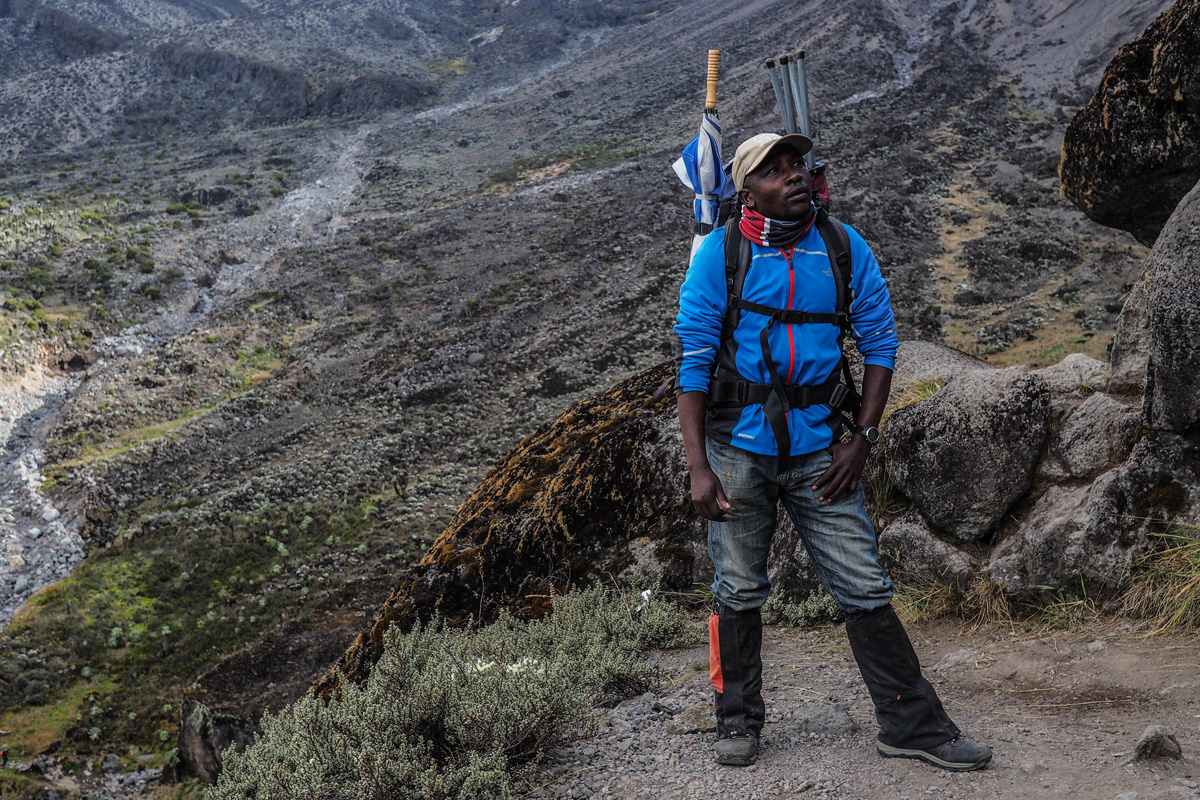
Anyone less than an accomplished alpinist, however, required guides and grunt labor to haul their amenities from camp to camp. It quickly became apparent that local youth would bear egregious loads up and down treacherous mountain ridges for a few dollar a day, already more than they could make on the family shamba.
A town like Naromoru, then, became and still is a hotbed of recruitment for mountain workers. Labor is already scarce, the farms unproductive, life generally arduous–it seems an obvious choice to carry bags for rich white tourists if only for the slightest chance of a tip or a hand-me-down jacket. More guiding companies are based out of Naromoru than any other city skirting Mt. Kenya. They don’t really have a better option.

As you drive through the town, you get the distinct impression that the whole place, not bigger than a few square kilometers, is eagerly waiting to jump up and grab your luggage. Men and boys line the highway that passes through town, lounging around fruit vendors arranging their meager goods on a torn-up tarp or a fundi welding together a long-defunct motorbike. Monstrous safari vans whip up dust on their way to opulent lodges and campsites, and occasionally a rattling flatbed will slow down long enough for a few lucky porters to hop in with their plastic grocery bags of warm clothing. As the dust settles, you see the silhouette of the mountain, hazy but implacable, rising up behind the line of dukas.

Tucked away into little corners of the town are local companies like KG Mountain Expeditions and Mt. Kenya Guides and Porters club. They might occupy the back room of an agrovet, but they generate more income for the town than every agrovet and feed store combined. Almost every boda-boda driver, mechanic, and farmhand has had a turn carryings bags up the mountain, but there are still never enough jobs to go around.
The only option, again, is to wait–to wait for a chance to freeze their digits off, get mountain sickness, break an ankle, all to earn their family enough for a few sacks of maize. Those left behind watch and wonder what it’s like up on this monolith that fills their skyline, up on its icy slabs and sodden swamps.
On my way out of town on a recent visit, I pulled off the highway to ask some local men resting under a bus-stop, the sole shelter from the furious wind, if they’d ever tried to climb the mountain. A man named Daniel told me with noticeable resentment, “Only the visitors have the capital, and so they are seeing instead of us the great prize of our own country.”
Mt. Kenya is no longer the seat of God to local Kenyans, but it is just as inaccessible.


More from this Author
-

Alone on the Roof of Africa
The Great White Mountain. Kilima Njaro. Ol’doinyo’oibor. The Roof of Africa. No mountain captures the imagination quite like Africa’s tallest, the biggest and
-
The Men of Kilimanjaro
My guide would alternately march ahead of me to set a brisk pace up the ashen volcanic scree and fall far behind me
-
Permit Me A Story
This is the story of a permit, or permits, or rather dozens of different forms and files and flagrant red tape that I
Ready to Travel?
Are you curious and ready to dream big? Do you desire to challenge yourself and make a meaningful difference? Become a Lumos Traveler - let’s get you started!